.png)


BOSTON, June 30, 2026 — Every day, law enforcement and government agencies ask private companies to hand over data those companies hold about their users. Account records, communications, location history, the most sensitive information an organization keeps. Today Kodex unveiled the infrastructure that carries those requests: a structured, automated, and verified rail that moves a request from the moment a government submits it to the moment a company is ready to respond. The announcement came at the company’s second Kodex Global Keynote and closed with the global premiere of The Call, the first Kodex original documentary, on a real case the network helped solve.
Last quarter, Kodex named the network: 15,000 agencies and 150,000 verified investigators, one trusted place where agencies and companies exchange data. Today is about what runs underneath it. For years, a government request landed and a person at the company read it, interpreted it, found the data, and sent it back, one step at a time, by hand. Kodex is now the infrastructure that carries the full lifecycle. The request gets to the right place, gets understood, and gets acted on, with verification of who is asking underneath every step.
This is a consequential category, and a contested one. The volume of government requests for user data climbs every year, and the expectation is that companies respond fast. At the same time, AI has made it cheaper and more convincing to fake one. Kodex’s own threat intelligence has tracked compromised government email accounts, forged court orders, and fraudulent requests sold as a service, all aimed at tricking companies into handing user data to people posing as law enforcement.
“Government requests for user data are growing, and getting faster isn’t optional,” said Matt Donahue, co-founder and CEO of Kodex. “The only real question is whether they move on infrastructure you can verify and audit, or on fax machines and email from someone you can’t confirm. We built the rails.”
Reading the request, automatically. With AI Structured Data, Kodex reads an inbound request, extracts the data it asks for, and validates and structures it as it comes off the document. The first hour of an analyst’s day, the manual read and triage of a document that can run to hundreds of pages, now happens before anyone opens it. AI Structured Data launches for the US market, in English.
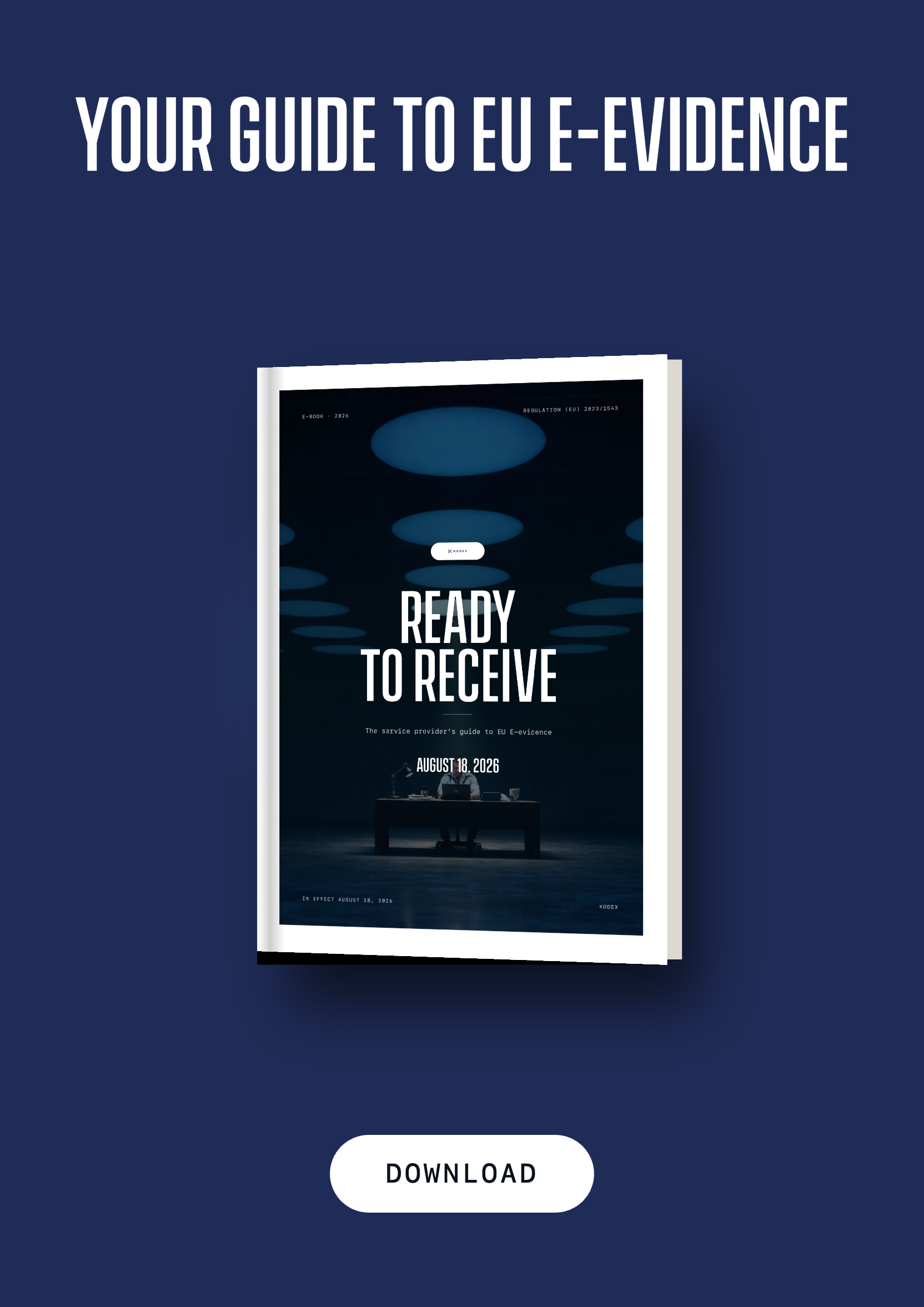
The front door, automated. With Intake Bridge, government systems hand requests to Kodex directly, system to system, already structured, with no human at the entrance on the submission side. The first place it goes live is the EU’s e-Evidence Regulation, which sets binding requirements and response times for cross-border requests and applies from August 18, 2026. Kodex operates an established secure channel for these requests under the Regulation. As EU member-state platforms come online later this year, Kodex customers connect through the intake process they already use.
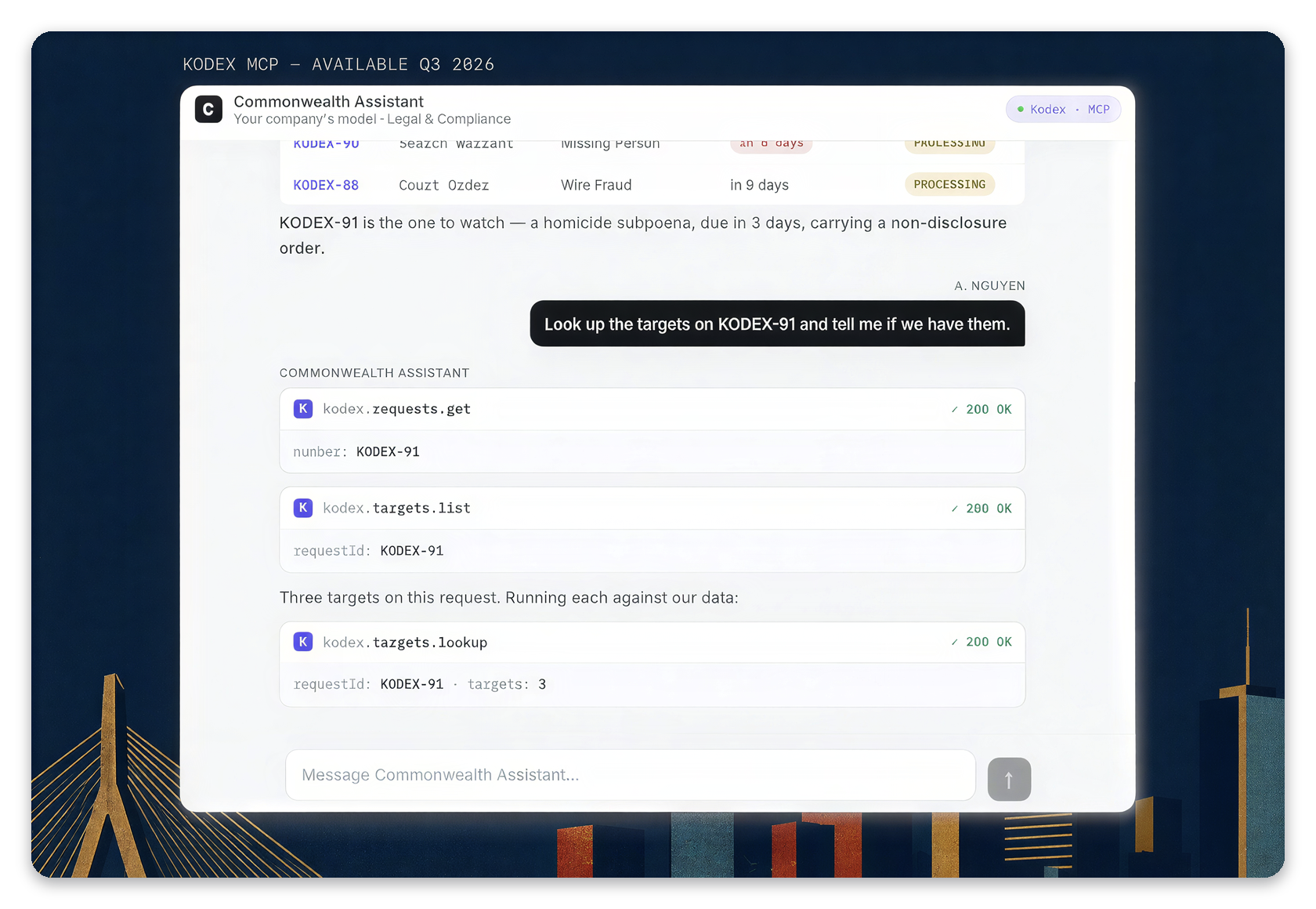
Bring your own AI. Kodex previewed a Kodex MCP server that lets a company’s own AI agent work the rail directly: find new requests, look up the data they ask for, prepare a response, and stage a case, through controlled, scoped, and auditable tools. Every agent action is logged and marked as agent-driven. Enterprise customers asked Kodex to connect their AI agents to the network rather than build the plumbing themselves. The capability is forward-looking and not yet generally available.
The company still decides. None of this releases data on its own. The infrastructure verifies the requester, structures the request, and prepares the response, and a person at the company reviews it, decides what to produce, and approves every send.

“The system understands the request, finds the data, and prepares the response,” said Jesse Goodman, VP Product Delivery at Kodex. “But the person at the company still decides what gets produced and still hits send. The infrastructure does the work. The human makes the call.” The same verification that prepares a request, applied continuously to every requester, is also what protects users from the fraudulent requests Kodex’s threat intelligence tracks every day.
The keynote closed with The Call, a documentary short on a real case the network helped solve.
About Kodex
Kodex operates the Kodex Global Network, the verified network for law enforcement data requests, connecting 15,000 agencies and 150,000 verified investigators with the companies that hold the data they request. Learn more at kodexglobal.com.
Media contact
marketing@kodexglobal.com
Get Your Free Drone Autonomy Guide Today!

Featured Blogs
.png)