Caught at one company. Blocked at all.
Threat intelligence built into every Kodex product, not a feed you subscribe to.

.png)


A single company can only see what shows up at its own door.
Defending alone means late.
Sophisticated threats aren't visible from one vantage point. A compromised police email is used at multiple companies before detection. A spoofed agency domain hits three platforms before any sees it twice. Defending alone means defending late.
The Kodex Global Network connects 15,000 agencies and 150,000+ agents across 180+ countries. Every signal one customer detects benefits all. Fraudulent emergency data requests caught at one bank get caught everywhere.
That's the difference between defending alone and defending together.

15,000
Agencies
190 +
Countries
1,40,000+
Vetted agents
Detection runs on every signal, every sign-in, every time.
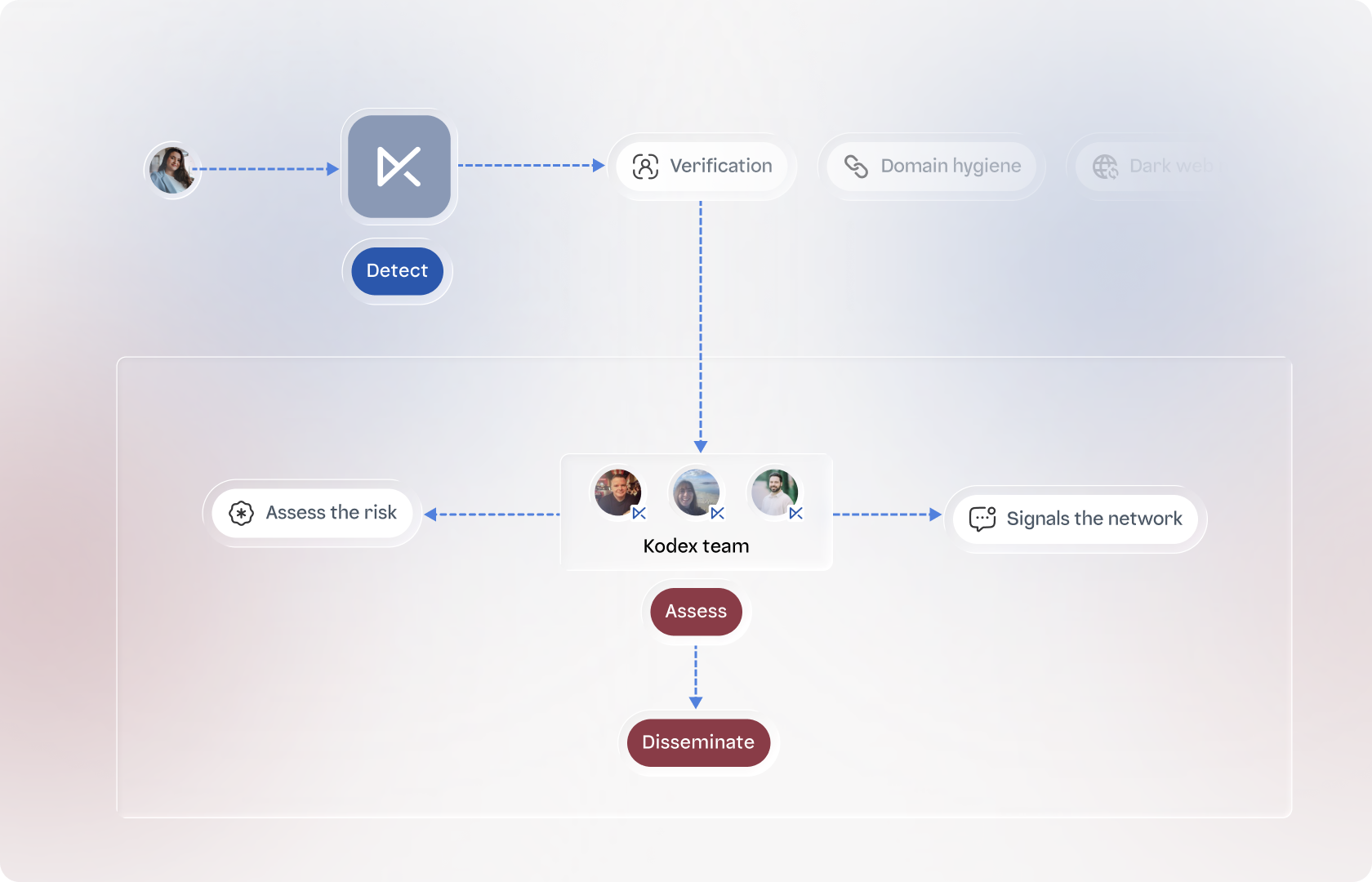
The detection layer reads sign-in metadata, runs domain checks on credentials, monitors the dark web for compromised accounts, and watches for behavioral anomalies in the user base.
A single signal in isolation is noise. A signal correlated against 150,000 others is intelligence.
Detection produces signals. Assessment turns signals into judgments.
The Kodex Threat Intelligence team, who run Verification On Demand, continuously analyze network data.
Unknown request
Requestor anomaly
Assessing the risk


Kodex team+ Network
Shares the threat signal to the network
Each country has a risk tier, from In Good Standing to Rejection Likely, based on real data. Threat actors are tracked across customers and time, linking patterns no single company could see.
The same domain spoofing used on three platforms, the same compromised credential surfacing in a new region: all connected here.
The judgment is the product. The signals are the input.
The intelligence moves in three directions.
Live propagation, network-wide.
When a credential is compromised, every active session using it is re-verified across every customer, automatically. No alert to triage, no patch to apply. The network updates itself.
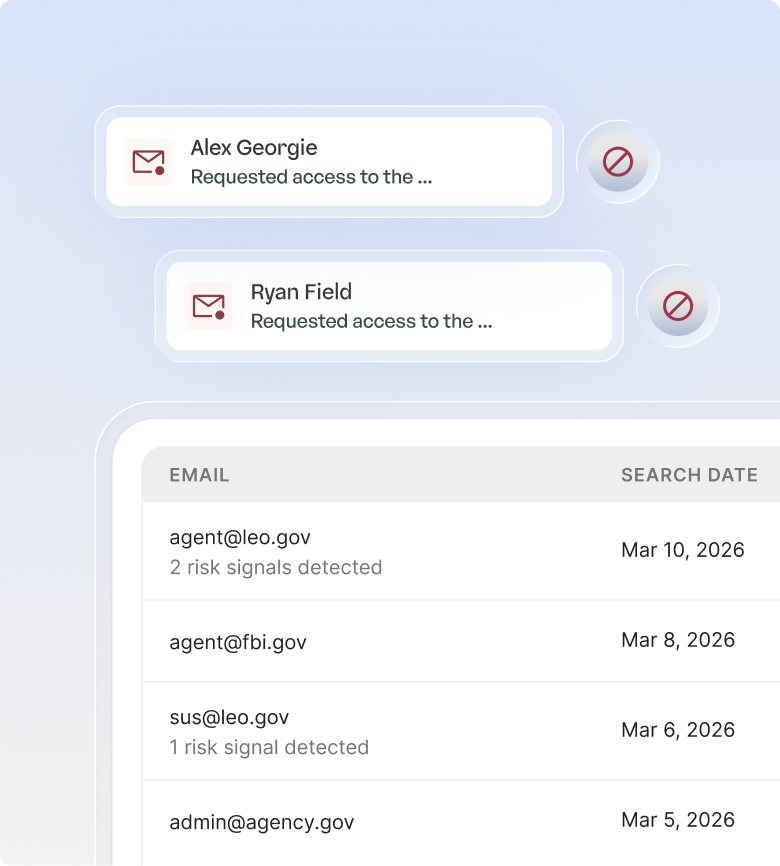

Threat alerts and threat briefings.
Threat alerts is a live feed of compromised emails and domains in Kodex Verify, searchable and integrated into your team's workspace. Threat briefings is the monthly intelligence report: what the network saw last month and what's coming next.
Read across the industry.
The Kodex threat intelligence newsletter is read across the industry, cited in regulatory briefings and quarterly reviews, and often names threat actors first.
Questions teams ask before they trust the network.
A threat feed sends you data and leaves you to figure out what to do with it. The Kodex layer is built into the products your team is already running. The same engine that verifies a requester is the engine that flagged the compromised credential they're using. No feed to integrate, no parsing to do, no separate workflow. Detection happens where the work happens.
The intelligence is the network, and the network is the customers using the platform. You can read the monthly Threat Briefing without being a customer. The live signal layer, the part that protects you in real time, only runs where the platform runs.
Threat Alerts is the live feed of compromised emails and domains inside Kodex Verify. Threat Briefings is the monthly narrative report from the Kodex Threat Intelligence team: what the network saw, what to watch next.
Live. A credential flagged at one company on the network is re-verified against every active session touching that credential on every other company on the network. There is no "syncing window."
The same analysts who run Verification On Demand on behalf of customers. They built the network and they work its data continuously. Threat profiles, regional risk tiers, alerts, and briefings come from this team.
Threat intelligence isn't a feature. It's what the network learns, shared.
The engine that protects one customer's intake also detects compromised credentials, spoofed agencies, and abuse patterns. Every customer's signals protect all the others.
.png)