Free report

Guide · Law enforcement email compromise
Law enforcement email compromise (LEEC) is an attack in which a criminal takes over a real police or government email account and uses it to send fraudulent data requests to companies. The request comes from the agency’s own domain, so the checks a company runs on the sender pass. This guide explains how the attack works, what happened at Revolut, and how to verify the person behind a request.
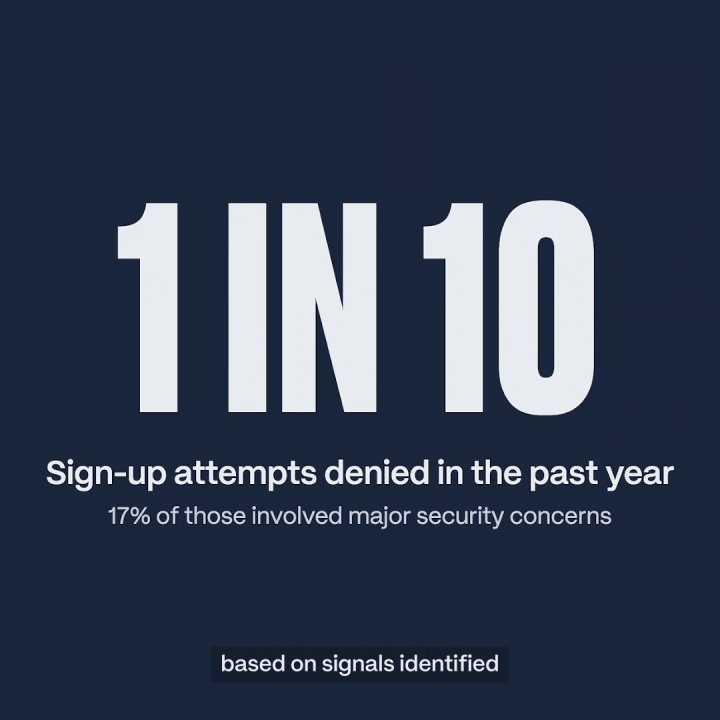
Ike Anude: A request can look legitimate and still come from the wrong person. A law enforcement mailbox can be compromised. Credentials can be stolen. Or someone who simply isn’t entitled to access can try to get in. And that’s why we think of Kodex as a secure front door to this process. And here’s what the data shows. Over the past year, we’ve denied one in ten sign-up attempts based on signals identified during verification. And 17% of those rejections involved major security concerns. This could be a suspected threat actor, compromised accounts, or other high-risk signals. Go back to the Revolut example. It only takes one. But with Kodex, they don’t make it through the front door.
Ike Anude, Engineer, Integrations
Kodex Global Keynote · October 27, 2026
Ike’s full answer01 · The attack
Companies that hold customer data have a legal duty to answer requests from police and government agencies. Many of those requests still arrive by email, and the team that receives one has to decide whether the sender is who they claim to be.
Law enforcement email compromise is the attack built on that decision. A criminal takes control of a real police or government mailbox and sends a data request from it. The message comes from the agency’s own domain, so every check a company runs on the sender passes. Kodex calls the pattern LEEC.
“A request can look legitimate and still come from the wrong person.”
Ike Anude, Engineer, Integrations, Kodex
The records go to someone whose next step is the reason they wanted them. Bloomberg’s reporting traced data from forged emergency requests to campaigns that sextorted women and minors. Fraudsters use the same data to defeat identity checks at banks and exchanges, and doxing crews use it to attach a home address to an online handle.
The emergency version of the attack has a guide of its own: fraudulent emergency data requests. A compromised account can also send forged subpoenas and forged court orders through the same trusted channel. For the short definition and the terms around it, see law enforcement email compromise in the glossary.
Free report
02 · The case
In September 2026, Revolut told customers that it had disclosed their records in response to fraudulent requests. Revolut says the requests came from a legitimate government email domain, with what it calls “valid domain authentication credentials.”
The records included identity documents, verification selfies and financial records. Reporting puts the number of affected customers at about 680.
Revolut later established that the requests were fraudulent. It blocked the address, notified regulators and police, and began emailing affected customers on September 11.
An attacker who controls a real agency mailbox can send messages that pass email authentication. Authentication confirms which mail server sent a message. Who wrote it is a separate question, and email has no way to answer it.
Much about the breach is still unconfirmed, including who sent the requests. Kodex’s report on the Revolut breach follows the reporting and separates confirmed statements from open claims. Matt Donahue’s account, written the week of the disclosure, and the day five update cover the first days.

Ryan: We have a reputation at Kodex for being the company’s most paranoid team. What we say to that is, just because we’re paranoid doesn’t mean they’re not out to get us. I can go to a dark web forum right now and find police and government email logins for sale for as little as twenty bucks. An extra forty, and you can get a forged ID to go along with the login. And thanks to AI, these threat actors are inventing new and more sophisticated attack methods every single day. Honestly, if you’ve seen what we’ve seen, you’d be paranoid too.
Ryan: For six years, our team has had one job, keep imposters off the Kodex Global network. We’re a large international group of investigators, and we use a lot of tools and processes to keep threat actors out. We’ve verified more than a hundred and sixty thousand investigators from over fifteen thousand agencies in more than a hundred and eighty countries. I can’t say much about how we do it. If threat actors learn too much, they adapt, and the network gets harder to secure.
Ryan: What I can tell you today is that the system is evolving. You’ll never see it or use it directly, but you’ll see the results. We call it Citadel is the world’s first application that uses AI to detect threat actors among government users. This year, we brought on a team of ML researchers and left them loose on what they love most, data. Kodex has the world’s largest set of data on threat actors using government accounts. We’ve tracked thousands of confirmed threat actors, and we track dozens of technographic and behavioral signals on top of their domains. Put that data in front of machine learning experts and experienced threat investigators, and you get the same best in class threat detection that secures the Kodex global network, but potentially many times faster.
Ryan: Let’s look at an example. This is an investigator at a small regional force signing up at her station. Citadel runs in the background while she fills in the form. Her sign up comes back clean, and she’s verified. If anything didn’t look right, her sign up would have come to us, and one of our investigators would take it from there. As long as her account stays in good standing, she won’t need to do this again. But that doesn’t mean we don’t keep tabs on her. She may need to get reverified later, for example, to send emergency requests or to reach out to companies that she wasn’t approved for. And Citadel keeps watching for signs of compromise. The moment something doesn’t add up, the account gets flagged and sent back for reverification. By the end of the year, every new sign up will go through Citadel. Real investigators will get in faster, and threat actors will still have to go looking for easier targets.
Ryan, Threat Intelligence Specialist
Kodex Global Keynote · October 27, 2026
Ryan’s full answer03 · The market
They are bought and sold. In November 2024 the FBI warned of a rise in criminal forum posts selling government email credentials, some of them marketed for fraudulent emergency requests. The sellers claimed access to accounts in more than two dozen countries.
The trade now runs as a service. Listings for a fraudulent emergency request start at roughly $100 for a how-to kit and reach $1,000 to $3,000 for a completed request. A verified police email account sells for around $1,000.
Supply is steady because police agencies around the world have uneven security. Many lack protections a company would expect, such as single sign-on or two-factor authentication, and one stolen login from any of them is enough.
Email is one route among several. In 2025 a group created a fraudulent account inside Google’s Law Enforcement Request System. Google caught it and said no requests were submitted and no data was accessed. The channel that law enforcement requests travel through is now a target itself.
Kodex has flagged more than 5,000 criminals impersonating law enforcement to get customer data. In the clip, Ryan, a Threat Intelligence Specialist at Kodex, explains how a sign-up is screened for the marks of a known threat actor before the account can send anything. See what the network catches.

Jane Man: Every law enforcement agent that signs up is verified before they can send anything to any of our clients.
Jane Man: So if anything looks off, we will actively monitor all these signals, and anything that’s off or gets flagged, our team is on it and looking closely at it, and we will suspend the account so they can’t send a request. So I personally, before Kodex, I spent a decade in cybersecurity, so I know that the threat landscape is constantly evolving and how important it is to never get complacent. So we’re constantly evolving our detections as well, looking for new signals, new techniques, new ways to detect this anomalous activity. And this is really the core of it. It’s defense in depth. If you’re thinking about doing verifications, you have to remember that no single signal is gonna catch everything every time. It’s all about the combination. Those signals layer together, and that’s what gives you that protection.
Jane Man, Product
Kodex Standard Report webinar · November 17, 2026
Jane’s full answer04 · The check
Most intake processes check the channel. They confirm that the sending domain belongs to a real agency, that SPF and DMARC pass, and sometimes that the domain is on an allowlist. During a LEEC attack every one of those checks returns a true answer.
Verification that holds up is about the person. It answers three questions, each one independently:
No company can answer the third question alone, because no single company sees enough requests to know what normal looks like. On the Kodex Global Network, 15,000 government agencies and 160,000 investigators are verified once, and their request behavior is visible across every company they contact.
“No single signal is going to catch everything every time. It’s all about the combination.”
Jane Man, Product, Kodex
Email checks won’t show a compromised account, because the account is real. The useful signals are in how the request behaves:
None of these is proof alone. Each is a reason to verify before disclosing.
The full manual process is in how to verify a law enforcement request. To check one sender today, Kodex Verify is free.

Ike Anude: When we look at the suspensions, they’re not attacks and they’re not from people we can confirm as threat actors. So out of the 727 accounts that were suspended on security grounds, only 56 of them were actually assessed as being compromised or being actual threat actors. Most of them, 671 of them, were for anomalous activity. So this could be something along the lines of maybe they log in from a location or through an IP that is very different than what they usually do or what their agency does.
Ike Anude: And this goes to show that, A, we are hypersensitive, which is a good thing in this case because we’re trying to make sure that everyone who accesses the platform is verified and that our front door is working. And it is a lot better to reject and then reconfirm someone than to allow someone in. So we’d rather fail closed than fail open because it only takes one for an attacker to compromise the network.
Ike Anude, Engineer, Integrations
Kodex Standard Report webinar · November 17, 2026
Ike’s full answer05 · The numbers
Over the past year, Kodex denied 1 in 10 law enforcement sign-up attempts, based on signals identified during verification. Of those rejections, 17% involved major security concerns, such as a suspected threat actor or a compromised account. Both figures come from the Kodex Standard Report.
Verification continues after sign-up. Kodex keeps monitoring signals on every account and suspends any account that gets flagged. When Kodex detects a compromised law enforcement domain, every Kodex customer is notified, and the accounts on that domain are suspended until they pass re-verification.
Most security suspensions are precautions, triggered by something like a login from an unusual location or IP address. Ike Anude gives the counts in the clip.
The effect reaches every company on the network: a requester who fails verification at one company has failed it at all of them. No single layer makes fraud impossible, which is why verification is paired with monitoring and the power to revoke an account. How requester verification works.

Samantha Rodriguez: My team handles thousands of law enforcement requests every year, every one of them with different processes, different legal standards, different levels of urgency. You can’t manage that over email. You can’t do it with spreadsheets and good intentions. That’s why we joined the Kodex Global Network, and I wanna be specific about that word, joined. We didn’t just buy a tool, we became part of a network.
Samantha Rodriguez: When we joined that network, everything changed because now when a request comes in, the agent on the other side is already verified. We know their credentials have been checked, not just once, but continuously. And on their side, they know exactly how to reach us, what we need to see, what our guidelines are. Both sides are operating from a position of trust.
Samantha Rodriguez: Since we joined the Global Kodex Network, we have not had a single fraudulent law enforcement request make it through the platform. Not one, zero. And that’s not like people aren’t trying. We had a case come through in email. Everything looked right, the formatting, the legal language, the domain. If we had been operating the old way, that request might have gone through. But because we route everything through Kodex Global Network, we could see immediately that the requester wasn’t verified.
Samantha Rodriguez, Senior Global Intelligence Project Manager, Coinbase
Kodex Global Keynote · March 25, 2026
Samantha’s full answer06 · In practice
Samantha Rodriguez is Senior Global Intelligence Project Manager at Coinbase. She says that since Coinbase joined the Kodex Global Network, not a single fraudulent law enforcement request has made it through the platform.
For her team the change is in what arrives. Every requester on Kodex is already verified when a request comes in, and Coinbase can see immediately when one isn’t.
The pressure on that team is rising. Request volume is growing roughly 40% a year, which leaves less time to check each sender by hand. The average turnaround on the Kodex network is about 15 hours, and the industry average is about six weeks.
A team shouldn’t have to choose between moving quickly on a legitimate investigation and protecting its customers. With the requester verified before the request arrives, the team’s time goes to the legal process and the response. Read how Coinbase works with Kodex.
FAQ
Email checks won’t show it, because the account is real. Look at how the request behaves: an account with no link to the agency’s jurisdiction, a first-time requester pressing unusual urgency, resistance to a callback, or a scope wider than the stated emergency. Then verify the individual through a channel the mailbox doesn’t control.
Domain spoofing is sending a request from an address that imitates an agency’s domain, or from a lookalike domain. Email authentication checks such as SPF, DKIM and DMARC usually expose it. Law enforcement email compromise is harder to catch, because the request comes from the agency’s genuine mailbox and those checks pass.
LEEC is the takeover of the email account. A fraudulent emergency data request is one thing a criminal does with that account, and the most dangerous. The same account can also send forged subpoenas and forged court orders.
Verifying the requester stops it. Because the mailbox is genuine, the reliable defense is confirming that the individual sending the request is a serving officer with the authority to make it, through a check that doesn’t depend on the mailbox.
Use a unique password for every account and require IT approval for password changes. Enforce multi-factor authentication with an authenticator app or a hardware key. Delete unused accounts, and keep logs of logins and system access. Watch for unusual deletions, unrecognized devices and logins from unexpected IP addresses.
Request a demo
Secure, configurable, intuitive end-to-end platform that boosts performance, protection, and peace of mind.
We use cookies to keep the site running, understand how it's used, and measure our marketing. You choose what to allow — read more in our Privacy Policy.
